Powerstep Pinnacle Insole Reviews: Ultimate 2026 Guide

Dr. Zac Cartun, MD
Doctor of MedicineOur Verdict
✓ Pros
- High and rigid arch provides significant support and weight distribution
- Orthotic Shell is made of a strong plastic which does not deform easily
- Thinner Foam layer (3MM) provides an energy transfer ideal for runners.
- 45 degree Angled Heel Cup provides weight distribution away from the heel.
✗ Cons
- Toe area has no corrections and is just foam
- Wide heel area will not fit in narrower shoes
- Angled heel cup is not great at locking heel in place to prevent pronation
- $50 price point is on the higher end for an off the shelf product.

Who should buy
-
Those looking for an all-around orthotic that provides solid arch support, a deep heel cup, and thoughtful construction.
-
Those with medium to high arches that collapse on stepping down and thus need extra support
-
Those suffering from mild plantar fasciitis will benefit from the high arch support, deep heel cup, and EVA foam mid-layer.
-
Athletes – those who will benefit from Powerstep’s high energy return and spring like arch support.
Who should not buy
-
Those with moderate to severe plantar fasciitis. The more spoon shaped heel cup struggles at keeping the important heel fat pad directly below the plantar fasciia.
-
Those with pain in the toe or ball of the foot. The orthotic element only goes up ⅔ of the sole and the rest is a thin cushion
-
Those just looking for a plush cushion and no arch support – The Powerstep has a pretty aggressive 30mm arch
-
Those with very flat feet. The high arch might be too painful even after some wearing in (Powerstep has a low arch version that would be better suited for you).
-
Those looking to save a few bucks. At $55 dollars on Amazon (more in retail), this is not a cheap over the counter product.
-
Anyone looking to put the insole in a narrow shoe (like ski boot) as the insole is very wide at the heel area.
Material Overview
| Layers | 4 |
|
Top Layer |
Microfiber |
|
Middle Layer |
EVA Foam |
| Shell | Polypropylene Plastic |
| Bottom | Rubber |


On top we have the standard microfiber layer to prevent liquid from getting into the orthotic as well as providing a strong surface to prevent your foot from digging into the middle foam.
As mentioned, under the top layer is a thin 3MM foam section. As we will talk about later, this is a generally squishy foam compared to other brands with a 46 Sh A hardness. A comparable would be an eraser at this hardness.
Core Orthotic

From the heel to the ball of the foot, we have a white plastic orthotic shell. This is the root of the product, and is impressively stiff and well shaped. The arch height is robust, giving the rest of the orthotic its shape around it. Its interesting to note that the white core is sandwiched between the foam at the base area.
The orthotic core of the Powerstep is the best we have seen in off-the-shelf products. In fact, it is almost identical to the $800 orthotic shell we picked up from a top Podiatrist in NYC. The arch resisted deformation until about 19.6 newtons of force was applied. This is close to 2x stronger than the force needed with superfeet.
We also like that the core is sandwiched between the top and bottom foam, meaning there is shock absorption across the foot.
Bottom Layer

Finally, on the bottom of the orthotic is a thin rubber layer. This provides added grip to the floor/shoe and repels any water coming up through the insole. The downside of this approach is that odor will get trapped in the insole, with nowhere to escape.
Metatarsal (Met) Pad

Powerstep does not have a metatarsal pad in their orthotics.
Depending on your condition, this isn’t necessarily a bad thing. Med pads are mainly useful if you have pain in the ball of your foot around the 2nd or 3rd metatarsal heads, or Morton’s neuroma. With a small indent they relieve pressure off that part of the foot onto other areas.
That being said, if your pain is concentrated in the arch or heel, met pads are not really needed. Additionally, it’s risky putting a met pad in an OTC insole as foot shapes vary so much that the pad might not be in the right place.
Arch
| Arch Height (no load) | 30MM |
| Arch Height (load) | 20.7MM |
| Quality | HIGH |

The arch is the most important element of any insole / orthotic. In a normal foot, the arch acts as a natural spring, collapsing slightly like a shock absorber to dissipate pressure across the foot. It also allows the foot to pronate, which is essentially the foot rolling slightly inwards while in gait. This gives the foot more time to distribute pressure and is a necessary movement.
With no arches, the foot cannot properly pronate. Instead of gradually hitting the ground, it is abrupt,like a pancake, which puts pressure on joints.
Arch Height
The arch height on the powerstep comes in at a whopping 31MM. This is the highest arch height we’ve seen in all the OTC insoles. For example, Superfeet green came in at 8.5MM.
From a corrective orthotic standpoint, this is a positive element. A bigger arch means that more of your weight can be distributed across the foot and the orthotic can do its job by acting as a spring that collapses slightly when you step down and springs back at take-off. There is also a nice secondary effect of improving gait mechanics by preventing overpronation.
If you are expecting an insole with a simple cushion, this is not that product. The raised arch will definitely feel strange on first wear, potentially up to a week or two. This is not a bad thing however. It simply means your foot and body are getting used to having the arch support that was not there previously. The only time we recommend completely stop is when you are truly in pain that does not go away even after time.
Arch Strength
A proper arch is supposed to be strong enough to keep most of its shape under load yet depress down just a bit to act as that shock absorber. Powerstep did a perfect job of this. We can see under load, the arch dropped from 30MM down to 20MM CM, which is in line with top of the line custom orthotics which average around the 30% drop in height on step.
One reason it was so responsive is that the underside of the arch is empty, it’s not like superfeet where the foam reaches all the way to the floor. Here, the foam and orthotic is thin, so it’s sort of ‘floating’ in the air.
Heel


Powerstep has a relatively deep heel cup, measuring in at .8 inches. This is about the same height as superfeet, yet 2x the height of an insole like BILT labs.
One important note is the heel cup is not vertical like Superfeet, but more coming out at a 45 degree angle from the center (think a spoon vs a bucket). The advantages of this is a more natural movement as the heel is guided into the right place rather than just locked in. This makes it easier to wear just out of the box and is more forgiving in sports.
On the other hand, this contoured heel cup does a worse job of keeping the important fat pad directly under your heel in place. Also, it doesn’t do a great job of preventing the heel from rolling/shifting underfoot while in motion which are normal irritants of plantar fasciitis.
Finally, this spoon shaped heel comes out to 20% wider versus Superfeet. Powerstep thus might not be able to fit into narrower heeled shoes like ski boots or soccer cleats.
Toe Area

The toe area does not have any corrections in it. The orthotic element itself stops about ⅔ up the insole, leaving just the microfiber, foam, and rubber sole. Like many OTC orthotics, this leaves a lot to be desired.
A pad under the toes, often called a crest pad will help people with things like claw and hammer toes, or just general inflexibility. They put the toes in a more natural position and reduces pressure off the tips of toes. Lastly, toe ‘corrections’ or ridges/dips encourage better rolling of the foot through the gait, training the foot to be in a better position overall and reducing long term chance of injury.
Energy Return / Shock Absorption.
Due to the thin layer of foam, there isn’t much on the orthotic to dampen the hard impact of a foot hitting the insole. In our Energy Return experiment, our 2LB ball bounced 5 inches off the ground when dropped from 12 inches up. This is 20% higher than superfeet which only bounced around 4 inches off the ground. This shows that the insole does well at rebounding energy, but not the best at absorbing shock.
Without much shock absorption, this does not make Powerstep the best insole for those who want to lesson stress on joints and ligaments.
Cushioning
 Rating: 46.5 SH
At 46.5 SH A, the powerstep top cushion is on the softer side. In comparison, superfeet had a hardness of 60 SH A. This is mainly due to the foam layer which lays right under the top microfiber top. Upon touch you can immediately see that this is a softer insole top, which we particularly liked while testing the product.
The foam itself is only 3.4mm thick, which is quite a bit less than the 5mm we see in the comparable superfeet model. Through online reviews, we can clearly see how that thin but soft cushioning starts to mold to the foot over time. This isn’t necessarily a bad thing however, as long as the orthotic shell itself stays strong, which it does.
Lateral Strength
Powerstep has robust lateral strength due to the plastic core layer. We do not suspect there will be any bend to the insole for quite some time.
Durability


Arch is intact even after active military duty (Via Amazon)
The integrity of hard plastic is generally on the more durable side. Through reviewing over 2K Amazon reviews, we saw almost no indication of the arch losing its shape over time. With that, the durability of the arch is easily 2 years.
The issue with Powersteps durability is that the microfiber top layer starts to fray pretty quickly (6+ months). With lack of a heel cup to lock in the foot, the heel moves around and creates abrasions in that area. We can see this type of result in the photos below.
Video Review
Watch our video review on youtube.
Reviewed for clinical accuracy by Dr. Zac Cartun, MD, Chief Medical Officer at Stride Soles. Last reviewed April 2026. This article is for informational purposes and is not a substitute for medical advice from a licensed clinician.

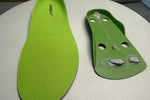
Powerstep |
Superfeet |
|
|---|---|---|
| General Stats | Powerstep | SuperFeet |
| Shoe Type | Non-Custom OTC Insole | Non-Custom OTC Insole |
| Imprint Method | N/A | N/A |
| Shipping Time | 2 Day (Amazon) | 2 Day (Amazon) |
| Weight | 30.6 grams | 52 grams |
| Price | $45 | $55 |
| Length | Full length | Full length |
| Durability | 6 months | 6-12 months |
| Components | Powerstep | SuperFeet |
| Layer Count | 4 | 3 |
| Top Layer | Microfiber | Microfiber |
| Cushioning | EVA Foam (3.4mm) | EVA Foam (5mm) |
| Bottom Shell | Plastic | Plastic |
| Toe Corrections | None | None |
| Arch Height | 16.5mm | 8.5mm |
| Arch Strength | Semi Rigid | Soft |
| Metatarsal Pad | None | 1mm |
| Heel Cup Height | 19.8mm | Low (1cm) |
| Performance | Powerstep | SuperFeet |
| Shock Absorption | Low | Medium (110 SA) |
| Energy Return | High | Medium |
| Hardness | Medium (SH A 46.5) | High (SH A 60) |
| Stiffness | High | High |
| Stain Resistance | Medium | High |
| Moisture Wicking | 1.5 hours | Low (5 hrs to dry) |
| Breathability | None | None |


