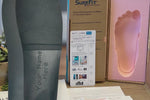
Note: Dr. Zac Cartun MD serves as CMO of Stride Soles. Full testing methodology is documented below so you can evaluate the results independently.
Bilt, Stride, and Upstep in a row
Packages Have Arrived
For this experiment I ordered custom orthotics from three of the most talked-about brands: Upstep, Bilt Labs, and Stride - placed on the same day, April 7, 2025 - and tracked every step of the process.
Comparing Each Insole, BILT has the lowest arch and barely-there heel cup
Dr. Zac Live Testing Upstep
The three brands approached customization across two methods, foam impression kits and 3D scanning with a smart phone:
Upstep: mailed foam impression kit that you step into and send back
Bilt Labs: foam impression kit with similar mail-in workflow
Stride: smartphone app captures a 3D scan of your feet, matched with a podiatrist
Dr. Zac Cartun, MDDr. Delia Sanders, MD
The tests were performed by myself, Dr. Zac Cartun, MD with assistance from Harvard University trained Dr. Delia Sanders, MD. I am a licensed medical doctor, trained at UMASS Chan Medical School, with a particular passion for tech based health solutions. While I am also Chief Medical Officer of Stride Soles, we performed each test without bias.
Methodology
After arrival, I put each insole through the same standardized battery of tests , with the same tools, for all three brands:
Weight: calibrated kitchen scale (oz)
Ball Drop Test: 2lb ball dropped from 12” height onto the toe and heel zones. The ball’s bounce height is recorded in inches: a higher bounce indicates greater energy return, while a lower bounce indicates better shock absorption. The two are trade-offs — a softer insole absorbs more impact but returns less energy to the stride, while a stiffer one springs back faster but transfers more force to the joints.
Arch Height: ruler from flat surface to peak arch (mm), measured both unloaded and under body weight. The arch is the most important element of any orthotic. In a normal foot, the arch acts as a natural spring, collapsing slightly like a shock absorber to distribute pressure and allow proper pronation — the controlled inward roll of the foot during each step. Without adequate arch support, the foot hits the ground abruptly instead of gradually, placing excess stress on joints and soft tissue. We look for an arch that holds its shape under load while still allowing a healthy 25–30% deflection.
Moisture Wicking: A measured volume of water poured directly onto the insole surface, timed until fully dry. Sweat management matters because trapped moisture accelerates odor, degrades foam, and reduces grip between the foot and insole surface. Materials like perforated leather tend to wick and evaporate faster than dense synthetic foam, which traps moisture between layers even when the surface appears dry.
Stain Resistance: standard ketchup applied to the insole surface for a set contact time, then wiped clean and rated 1–5. This stress-tests whether the top material can repel common contaminants without permanent discoloration, which is a proxy for how well the surface will hold up to daily grime and perspiration over months of wear.
Lateral Strength: twist and bend test scored 1–5. Lateral stiffness is critical for overpronation correction: a shell that flexes easily underfoot cannot hold the foot in a neutral position during the push-off phase of gait. We apply controlled torsional force along the long axis of the insole and assess how much the midfoot and forefoot deflect relative to the heel.
Cross-Section Cut: insole cut in half to inspect internal construction: layer count, material quality, foam thickness, shell extent, and adhesive integrity. This is the single most revealing test. Marketing language about “3D printing” and “premium materials” is easy to claim; the cross-section shows exactly what is actually between your foot and the floor.
Heel Cup Depth: ruler from the bottom of the cup to the rim (mm). A deeper heel cup keeps the heel’s fat pad centered directly under the plantar fascia, preventing the heel from shifting laterally during each step. Cup geometry also matters: a vertical-walled cup locks the heel in place more aggressively, while an angled or “spoon-shaped” cup guides the heel inward more gently but may allow more movement during dynamic activity.
Upstep - Best 'Foam Box' Online Orthotic
Upstep Cut in Half
Upstep really is a solid insole for mild foot discomfort and first-time orthotic users. Their foam box method, while slower (26 days in total), did result in a pair which matched my foot and what I asked for. The pair was versatile in different shoes and helped to offset pressure around my foot.
I myself play a good amount of sports (particularly pickleball), so I appreciated the high heel to keep my foot from moving around during lateral movement. Additionally, with a robust arch, I was able to comfortably disperse load across my foot. This resulted in a overall positive experience wearing Upstep.
It was clear they put thought into the design of their orthotics, as you could tell it was made for my feet given the arch pretty much matched up exactly to what I needed. I'm usually skeptical of the foam box method, but they did a good job of reading my imprints.
One area which was disappointing was that the forefoot is unsupported.
Upstep uses a ¾-length orthotic shell covered by a full-length foam top. The foam extends to the toes, but the support stops at the ball of the foot. Given how important the toes are for the push-off and landing during gait, I was expecting more in that area.
Since the foam impression kit measured my feet heel to toe, there’s no reason they shouldn’t have the capability to include forefoot and toe modifications from a data perspective.
The insoles also had noticeably elevated heels, which shifts weight forward toward the ball of the foot (the opposite of ‘zero drop’ heels, which has been trending in the kinesiology space for the past decade or so).
Pros
✓ 180-day money-back guarantee
✓ Lightweight at 2.9 oz
✓ Friendly guided ordering experience
✓ Perforated synthetic leather top layer
✓ 200,000+ orthotics made — proven scale
✓ Reasonable arch contouring for mild needs
Cons
✗ Foam impression kit is imprecise
✗ No forefoot structural support (foam only)
✗ Elevated heel shifts weight forward
✗ Below-average moisture wicking
✗ No named podiatrist assigned to order
Who Should Buy Upstep
First-time orthotic buyers who want a friendly, guided experience
Those with mild foot discomfort rather than a diagnosed condition (particularly in the heel or midfoot)
People who value scale and service guarantees of a large established brand
Who Should NOT Buy Upstep
Athletes or runners who need forefoot support and energy return
Those with metatarsalgia or toe pain (again, there’s no toe zone support)
Buyers who want to know exactly who built their insole and reviewed their case
Buyers requiring special modifications based on previous podiatric custom insole design
Ordering Process
Upstep keeps things light and visual stylistically, guiding you through a friendly form in under two minutes. It covers prior orthotic use, pain location via body-map, diagnosed conditions, and shoe size.
Three days after ordering, a foam impression kit arrived. The process was polished, with a QR code linking to a video tutorial. Upstep sent a standard order confirmation, a purchase receipt with an estimated timeline.
The insoles arrived May 3, 26 days total. Packaging was quite nice and the insoles were pre-trimmed and clearly labeled. A reasonable turnaround given the manual steps.
Material Overview
Top Layer
Synthetic Leather (Perforated)
Midsole
EVA Foam
Shell
¾-Length Plastic — no forefoot coverage
Layer Count
3 Layers
Upstep uses a three-layer construction: a perforated synthetic leather top, an EVA foam midsole, and a ¾-length plastic shell. As mentioned, the shell only extends about two-thirds of the insole length, leaving the forefoot area as foam only with no structural correction.
Metatarsal Area
Metatarsal Support
Yes - Aggressive
Upstep provided a ‘bump’ in the forefoot that served as metatarsal support. As someone who doesn’t suffer from metatarsalgia, the bump was noticeable but not painful. I was a bit curious about why it was there, given I didn’t mention pain in that region during the intake questionnaire.
Arch
Arch Support Quality
High
Arch Longevity
Solid-plastic, high longevity
Upstep offers a moderate arch with moderate shaping in the midfoot. The rigid plastic is likely to last a long time and seems to be of high quality. Overall, solid.
Heel Cup
Heel Cup Depth
Medium–Deep
Weight Distribution
Elevated heel shifts weight forward
The heel cup is another relative strength for Upstep since it was deep enough to hold the foot in place and limit lateral movement. However, the elevated heel height itself shifted weight forward toward the ball of my foot, which some say can be a long term injury risk. IN the short term, however, it was comfortable enough.
Forefoot
Forefoot Support
None — flat foam only
This is where Upstep falls short. The forefoot is just foam, no structural elements, no no corrective shaping. For metatarsalgia, Morton's neuroma, or general forefoot fatigue, Upstep provides no targeted relief. With all of this said, as someone who has seen many podiatrist-made custom insoles, Upstep isn’t necessarily out of place. It’s just that it seems like a cop out. If the forefoot wasn’t necessary to correct or contour, I feel like the site should make note of this.
Cushioning
Shock Absorption
Medium
Energy Return
Medium
Foam Density
Medium-Dense EVA
Hardness
12.5 SH A
Lateral Strength
The plastic shell gives Upstep extreme resistance to lateral bending in the rear ¾. However, because the shell doesn't extend to the toe, the forefoot folds easily under lateral force.
Lateral Strength Score
3 / 5
Weight
Weight (single insole)
2.9 oz — Lightweight
Moisture Wicking
Moisture Wicking
Medium
Dry Time
Longer than average
Upstep's perforated synthetic leather top seemingly offers some moisture management, In our dry-time test, the insole took longer than expected. The porous plastic underneath traps moisture despite the perforated surface. It’s a bit like putting a screen in front of a closed window and asking, “How’s the ventilation?” Elapsed time to dryness was 1 minute and 48 seconds.
Breathability
Breathability
Low
Again, the perforated top layer seemingly allows some airflow, but the solid plastic beneath prevents meaningful ventilation. I would probably expect odor to develop with extended daily wear.
Stain Resistance
Stain Resistance
5 / 5
Upstep Passed the Ketchup Test
Durability
Expected Lifespan
3–5 Years
The foam-dependent surface means Upstep's longevity is tied to how quickly that foam compresses. We estimate 3–5 years of meaningful support before the foam flattens enough to warrant replacement.
Stride Soles - Best 'Digital Scanner' Custom Orthotic
Stride is the newest company that needs to compete with the big boys. It seems like they considered every element of the other companies’ designs and processes and tried to improve upon it.
The consequence was a generally better experience and product. The entire orthotic was customized all the way to the toe area, including a toe bar which for me was needed given my history of pain in that area.
If you want a super squishy, simple foam type orthotic or insole, I would look elsewhere. The orthotic is meant to correct your gait, so I was a bit sore wearing Stride at first. This is normal as your body adapts to your new walking mechanics and movement changes, but nonetheless it takes getting used to.
As I'll talk about later, the core material is made of a semi-rigid plastic shaped in a hexagonal pattern. The benefits are that it's lighter and allows for more airflow. However, as you see in the photo above, the mid foam layer can peek through so it may look strange from the bottom.
Among all three options, Stride was the only option to incorporate gait into their analysis and production. I was told by Stride that I actually had a bit of right hip drop, something that meant they added a bit more correction to offset my imbalance. For those with abnormal gait, this is a big plus.
Pros
✓ 3D smartphone scan - most accurate fit data
✓ Full-length structural support heel to toe
✓ Perfect fit - no trimming needed
✓ Highest arch support strength
✓ 180-day money-back guarantee
✓ Fastest turnaround — no mail-in kit
Cons
✗ Requires smartphone for 3D scan step
✗ Slightly heavier: 3.0 oz vs 2.9 oz
✗ Takes time to get used to (sore for a few days)
✗ Bottom can look unfinished given the use of hexagonal lattice pattern.
Who Should Buy Stride
Anyone with flat feet, plantar fasciitis, heel spurs, or overpronation
Athletes who need forefoot support and energy return
Those who've tried OTC insoles and want a genuine clinical-grade upgrade
Buyers who want to know exactly who built their insole and how
Anyone who values precision fit and full-foot customization
Who Might Hesitate on Stride
Budget-conscious buyers — $249 is a meaningful investment
Those without a smartphone capable of running the scan app
Casual users with no foot complaints who just want basic cushion
Order Process
Stride was perhaps the most clinically complex intake, asking about 24 anatomical pain zones, arch type, pain frequency, movement goals, and a free-text field. Because of the complexity it takes slightly longer to fill out, about a minute longer than the other quizzes.
The scanning process was done immediately via smartphone. After placing the order, the app was easy to pair using an emailed code that linked the questionnaire to the scanning app. The scan took about 30 seconds (15 per foot) with the ability to rotate and zoom the 3D model on-screen afterward. The gait analysis required propping a phone against a wall, hitting record, and walking forward and back — the whole thing took about 3 minutes total.
About 30 minutes after placing the order, an email arrived from their podiatry team explaining how they would design the insoles based on the specific responses — the only signal from any of the three brands that a real person was reviewing the data.
The insoles shipped April 15, just 8 days after ordering, and arrived April 20 — 13 days total. Packaging was sleek, branding clean, break-in instructions clear.
Material Overview
Top Layer
Premium Perforated Vegan Leather
Midsole
EVA Foam
Shell
Full-Length 3D-Printed TPU
Customization Method
3D Scan + Gait Analysis + Podiatrist Review
Uncovered Stride Soles Show Toe Corrections
The orthotic is 3D-printed from TPU (more flexible and durable than polypropylene) and extends the full length of the insole including structured elements in the forefoot and toes - a major plus which made it feel really custom (like my toes had individual grooves - it was pretty sweet). To finish the design,a vegan leather top layer sits over an EVA foam cushion.
Metatarsal Area
Metatarsal Support
Full structural support
Okay, last time I say this. Promise. Stride is the only brand in this test that actually provided structural support across the entire forefoot, including the metatarsals and toes. The full-length design means the ball of the foot and toe area are part of the corrective design, not just an afterthought. I suppose there’s risk to this as the more structural elements, the more things can ‘go wrong.’ In my case, however, the fit was like a glove.
Arch
Arch Support Quality
High, structural, not foam-dependent
Long-Term Arch Retention
Excellent, holds shape under load
The arch was also a unique stride feature. The medial arch was significantly more built up than the other brands. As a result, there was dual arch support and pronation support that prevented my feet from rolling inwards. This was quite comfortable and had an immediate impact on my foot fatigue.
Heel Quality
Heel Cup Design
Custom-contoured from 3D scan data
Weight Distribution
Balanced — no artificial heel lift
The Stride heel cup is fit the exact shape of my heel, slightly better than Upstep and much better than Bilt. In wear testing, the heel felt balanced and stable without the artificial elevation we experienced with Upstep and Bilt Labs. These insoles are truly zero drop and didn’t lead to any weight transfer to the forefoot.
Cushioning
Shock Absorption
High
Energy Return
High
Unlike the rigid plastic of Bilt and Upstep, Stride’s 3D printed lattice offers variable rigidity throughout. For instance, the lateral twist flexibility was quite high which enabled the insole to contort during high pressure movements (I used them for a tennis match). In contrast, the arch was highly rigid and supported my weight even on heavy impact. This unique design really set Stride apart from the single density plastic in Bilt and Upstep.
Weight
Weight (single insole):
3.0 oz — slightly heavier, still very light
We are talking about 3.0 oz vs. 2.9 oz - all the insoles were essentially the same weight. I suppose if I were running marathons competitively I might reconsider the 0.1 oz difference, but then again the comfort and elastic rebound in Stride might make up for it. Maybe this will be my next test.
Moisture Wicking
Moisture Wicking
High — fastest dry time of the three
Stride's perforated leather top performed well in our moisture wicking test, drying faster than both competitors. The vegan material handles sweat more efficiently than the alternatives, though this may have more to do with the breathable TPU lattice underneath vs. the rigid plastic arches. In our moisture wicking test, it dried in one minute and 2 seconds.
Breathability
Breathability
Highest
Stride’s 3D lattice offered superior breathability and is especially attuned for people with foot odor issues.
Stain Resistance
Stain Resistance
4 / 5
In our ketchup test, Stride's leather top performed well, wiping clean with a light scrub. Comparable to Bilt Labs and Upstep.
Durability
Expected Lifespan
3–5 Years — best in test
Because Stride's arch support is built into the TPU lattice rather than depending on glued-on foam, the corrective properties should last as long or longer than its competitors. We estimate 3–5 years of full support
Bilt Labs
Let me start by saying Bilt labs was really the most disappointing.
Bilt Labs has all the language of a premium brand "25 years of experience," "podiatrist-reviewed," "3D-printed" but the actual product (nor did the website) match the billing.
The material is all of high quality and the insoles were comfortable-ish, but there was almost nothing that stood out as truly custom. I mentioned earlier that there’s no forefoot support, but there wasn’t much arch or heel support either.
The arch was the least contoured of the three, the cross-section showed glue residue, and, like upstep, the foam impression kit limits precision. The 3D-printed shell is a plus, but not close enough to close the gap with Stride.
I was tempted to order another pair and “fake” my arches in the foam impression kit to see how similar the second pair would be, but I didn’t want to spend another $260 on the test.
Pros
✓ 3D-printed shell — more precise than standard plastic
✓ Foam midsole layer — natural and resilient
✓ Name engraved on shell — personal touch
✓ Good stain resistance on leather top
✓ Made in the USA
Cons
✗ Foam impression kit limits accuracy
✗ No forefoot structural support
✗ Required trimming out of box
✗ Internal glue residue visible on cross-section
✗ Minimal arch contouring — felt generic
✗ Worst moisture wicking of the three
Who Should Buy Bilt Labs
Those who appreciate the durability of a 3D-printed shell over standard plastic
Buyers who want a Made in USA custom orthotic
Mild conditions where basic arch and heel support is sufficient
Who Should NOT Buy Bilt Labs
Anyone with a serious foot condition requiring precise customization
Those with forefoot pain (no structural forefoot support provided)
Buyers wanting full clinical transparency and named practitioners
Those needing high moisture management (Bilt Labs is worst of the three)
Order Process
Arrival Time
26 Days
Bilt Labs kept the intake questionnaire fairly similar to the other brands, asking basic questions about my pain areas
Three days after ordering, a foam impression kit arrived alongside Upstep's.
The process was identical with two foam trays, instructions, and a prepaid return label — though Bilt Labs included a small paper questionnaire to fill out by hand, plus a paper document to sign acknowledging that turnaround could exceed a month.
The foam kit boxes were too large for standard street drop boxes, requiring a post office counter return. Bilt Labs sent a standard order confirmation with an estimated timeline.
The insoles arrived May 13, 26 days total — true to the paper disclaimer. Packaging was the plainest of the three.
Customization
Bilt Labs uses a ¾-length orthotic shell covered by a full-length foam top, with support stopping at the ball of the foot.
Bilt felt the least custom of the three — the surface was quite smooth with minimal contouring throughout, closer to the design of a high-quality OTC insole than a bespoke device.
Out of the box, the insoles were slightly too long, requiring trimming before they sat properly.
Material Overview
Top Layer
Perforated Leather
Midsole
EVA Foam
Shell
3D-Printed Polypropylene
Layer Count
4 Layers
Bilt Labs used a four-layer build: perforated synthetic top, dual layer EVA foam midsole, and a 3D-printed polypropylene shell (at least i think, it might have also been laser cut). The 3D printing theoretically allows more precise shaping than injection-molded plastic. However, our cross-section revealed visible glue residue and rough internal surfaces, all signs that the construction quality doesn't fully match the premium positioning.
Metatarsal Area
Metatarsal Support
None
Like Upstep, Bilt Labs provided no dedicated metatarsal or forefoot support. The forefoot area beyond the ¾ shell is foam-only. No pads or corrective elements.
Arch
Arch Support Quality
Low–Medium
Arch Shape
Minimal contouring, felt generic
Despite the 3D-printed shell previously mentioned (which would seemingly allow precise arch contouring) the Bilt Labs arch felt the least custom of all three. The surface was smooth with minimal contouring. It felt closer to a high-quality OTC insole than a truly bespoke device. It didn’t ‘fit’ my arch in an obvious way that made me go “oh yeah, this is custom”
Heel Quality
Heel Cup Depth
Low
Heel Shape Retention
Good, 3D-printed holds form
BILT Heel Height
Bilt Labs didn’t offer a much of a heel cup. It’s worth pointing out I don’t have any ankle stability issues that warrant such a modification, so i didn’t find this to be a problem. In fact, it was a bit odd how high Upstep’s heel was in comparison. That said, I suppose each company has a different design philosophy and both heels were comfortable enough.
Forefoot
Forefoot Support
flat foam only
No Corrections in the toe area, which has 30% of pressure of the foot
I’m going to keep saying it because it’s just too surprising. Like Upstep, Bilt Labs provides no structural forefoot support. The area beyond the ¾-length shell is foam-only.
Cushioning
Shock Absorption
Medium
Energy Return
Medium
The dual EVA midsole combination is interesting. The first layer doesn't compress as aggressively as the pure foam. However, in our ball-drop test, shock absorption was only moderate, suggesting the construction prioritizes rigidity over cushioning. As an aside, most foam, gel, and other ‘cushioning’ devices on insoles are for show only. How is a 2-5mm thick piece of foam really going to handle the impact of a 200lb man running on concrete. Just food for thought.
Lateral Strength
Lateral Strength Score
3 / 5
The 3D-printed shell offered good resistance to lateral bending than expected. In our twist test, the material showed little flex. That said, the forefoot is pure foam that bends like paper. So…
Moisture Wicking
Moisture Wicking
Low — worst of three
Dry Time
Longest of the three brands
Bilt Labs had the weakest moisture wicking of the three. The surface absorbed moisture quickly and took the longest to dry. The foam top and dense midsole trap moisture between layers.
Breathability
Breathability
Low
Stain Resistance
Stain Resistance
5 / 5
In the stain test, Bilt Labs performed very well. The leather surface resisted the ketchup and wiped clean with minimal residue. A genuine strength of this brand.
Durability
Expected Lifespan
3-5 Years
The 3D-printed shell should outlast standard injection-molded plastic. However, the dual foam midsole and leather top will still degrade. We estimate 3-5 years of meaningful support.
Frequently Asked Questions
Do I actually need custom orthotics?
Not everyone does. If you have mild general foot fatigue, a quality OTC insole may be sufficient. However, if you have a diagnosed condition like flat feet, plantar fasciitis, overpronation, heel spurs, metatarsalgia, or if you've tried OTC options without relief, custom orthotics are definitely worth the investment.
What is the difference between insoles and orthotics?
Insoles are general-purpose cushioning inserts designed for comfort. Orthotics are medically designed devices intended to correct biomechanical issues. Custom orthotics are built specifically for your foot shape and condition. All three brands in this review claim to offer custom orthotics, though the degree of true customization varies significantly, particularly when it comes to forefoot and toe modifications.
Are custom orthotics ordered online just as good as from a podiatrist?
Like most things it depends. Online orthotics can easily replicate the same casting data collection that is done in person as the majority of Podiatrists use scanning/foam boxes in their clinic anyways.
The question comes down to who is interpreting the data and constructing the orthotic. In person, you might see a good podiatrist who perfectly translates what he sees into a great orthotic. On the other hand, they may just breeze through your appointment to try and fit as many patients in as possible. Online, which company you go through can also determine your outcome based on who exactly is looking at your data?
One thing to find out from a company is where the orthotic is getting produced. Is it getting made in China? Is it being done in house? There are many variables that must be considered.
What custom orthotics are best for plantar fasciitis?
Plantar fasciitis requires strong arch support to offload the fascia, and heel cushioning to absorb impact. Stride performed best for this condition, its structural arch is built into the shell (not foam-dependent), its heel cup is custom-contoured, and its full-length design supports the entire plantar surface.
Are custom orthotics worth it for flat feet?
Yes, but only if the orthotic has genuine structural arch support. Many "custom" insoles use foam to simulate an arch, which compresses under body weight and offers diminishing support over time.
Reviewed for clinical accuracy by Dr. Zac Cartun, MD, Chief Medical Officer at Stride Soles. Last reviewed April 2026. This article is for informational purposes and is not a substitute for medical advice from a licensed clinician.
Debug Info:
Article ID: 558360854592
Content length: 54341
Number of img tags found: 36
Found img part 2: style="margin-bottom: 16px; float: none;" alt="Bilt, Stride, and Upstep in a row" src="https://cdn....
Found img part 3: style="margin-bottom: 16px; float: none;" alt="Packages Have Arrived" src="https://cdn.shopify.com/...
Found img part 4: style="margin-bottom: 16px; float: none;" alt="Comparing Each Insole, BILT has the lowest arch and ...
Found img part 5: style="margin-bottom: 16px; float: none;" alt="Dr. Zac Live Testing Upstep" src="https://cdn.shopif...
Found img part 6: height="304" width="308" style="margin-bottom: 16px; float: none;" alt="Dr. Zac Cartun, MD" src="ht...
Found img part 7: alt="Dr. Delia Sanders, MD" src="https://cdn.shopify.com/s/files/1/0578/4066/4640/files/delia.jpg?v...
Found img part 8: style="float: none;" alt="Upstep Cut in Half" src="https://cdn.shopify.com/s/files/1/0578/4066/4640...
Found img part 9: alt="" src="https://cdn.shopify.com/s/files/1/0578/4066/4640/files/image1_2aa1ce36-39a9-4aee-9c20-7...
Found img part 12: alt="" src="https://cdn.shopify.com/s/files/1/0578/4066/4640/files/rrrr.jpg?v=1775102499">
Found img part 13: alt="" src="https://cdn.shopify.com/s/files/1/0578/4066/4640/files/metatarsal.jpg?v=1775083287">
Found img part 14: alt="" src="https://cdn.shopify.com/s/files/1/0578/4066/4640/files/image8.jpg?v=1774927775">...
Found img part 15: height="416" width="554" alt="" src="https://cdn.shopify.com/s/files/1/0578/4066/4640/files/image11...
Found img part 16: alt="" src="https://cdn.shopify.com/s/files/1/0578/4066/4640/files/image15_fa095dd4-6e87-457a-9863-...
Found img part 17: src="https://cdn.shopify.com/s/files/1/0578/4066/4640/files/shore.jpg?v=1775084192" alt="">...
Found img part 18: alt="" src="https://cdn.shopify.com/s/files/1/0578/4066/4640/files/image17.gif?v=1775084143">
Found img part 19: alt="" src="https://cdn.shopify.com/s/files/1/0578/4066/4640/files/image18_24d8111c-15dc-43f0-a4b2-...
Found img part 20: alt="" src="https://cdn.shopify.com/s/files/1/0578/4066/4640/files/image12_6a58ec6d-ab78-4b8b-9fd5-...
Found img part 21: style="margin-bottom: 16px; float: none;" alt="Upstep Passed the Ketchup Test" src="https://cdn.sho...
Found img part 22: alt="" src="https://cdn.shopify.com/s/files/1/0578/4066/4640/files/image5.jpg?v=1774927776">...
Found img part 23: alt="" src="https://cdn.shopify.com/s/files/1/0578/4066/4640/files/image34_99c49443-3a9b-44ec-9f9b-...
Found img part 24: alt="" src="https://cdn.shopify.com/s/files/1/0578/4066/4640/files/backstory_image8.png?v=177492777...
Found img part 25: style="margin-bottom: 16px; float: none;" alt="Uncovered Stride Soles Show Toe Corrections" src="ht...
Found img part 26: alt="" src="https://cdn.shopify.com/s/files/1/0578/4066/4640/files/tt.jpg?v=1775100164">
...
Found img part 27: alt="" src="https://cdn.shopify.com/s/files/1/0578/4066/4640/files/image32.jpg?v=1774927776">
Found img part 28: alt="" src="https://cdn.shopify.com/s/files/1/0578/4066/4640/files/image33_58727221-8ef5-43f3-918e-...
Found img part 29: alt="" src="https://cdn.shopify.com/s/files/1/0578/4066/4640/files/image37_4edf6260-d774-4e19-b93e-...
Found img part 30: alt="" src="https://cdn.shopify.com/s/files/1/0578/4066/4640/files/image20_69c0e392-90f2-4b40-b68e-...
Found img part 31: alt="" src="https://cdn.shopify.com/s/files/1/0578/4066/4640/files/image21_0724e96f-0367-4922-8764-...
Found img part 32: alt="" src="https://cdn.shopify.com/s/files/1/0578/4066/4640/files/image4_07acd816-a243-4f44-877d-b...
Found img part 33: alt="" src="https://cdn.shopify.com/s/files/1/0578/4066/4640/files/image22_6a9c8f69-3ec7-41e8-a0aa-...
Found img part 34: alt="" src="https://cdn.shopify.com/s/files/1/0578/4066/4640/files/image23_c82125dc-04ea-4b0b-9de0-...
Found img part 35: style="margin-bottom: 16px; float: none;" alt="BILT Heel Height" src="https://cdn.shopify.com/s/fil...
Found img part 36: style="margin-bottom: 16px; float: none;" alt="No Corrections in the toe area, which has 30% of pre...
Found img part 37: alt="" src="https://cdn.shopify.com/s/files/1/0578/4066/4640/files/image27_5c1e58cc-7603-41b7-b9eb-...


 Material Overview


 Upstep offers a moderate arch with moderate shaping in the midfoot. The rigid plastic is likely to last a long time and seems to be of high quality. Overall, solid.
 This is where Upstep falls short. The forefoot is just foam, no structural elements, no no corrective shaping. For metatarsalgia, Morton's neuroma, or general forefoot fatigue, Upstep provides no targeted relief. With all of this said, as someone who has seen many podiatrist-made custom insoles, Upstep isn’t necessarily out of place. It’s just that it seems like a cop out. If the forefoot wasn’t necessary to correct or contour, I feel like the site should make note of this.
 Lateral Strength


 Stride was perhaps the most clinically complex intake, asking about 24 anatomical pain zones, arch type, pain frequency, movement goals, and a free-text field. Because of the complexity it takes slightly longer to fill out, about a minute longer than the other quizzes.

 The arch was also a unique stride feature. The medial arch was significantly more built up than the other brands. As a result, there was dual arch support and pronation support that prevented my feet from rolling inwards. This was quite comfortable and had an immediate impact on my foot fatigue.
 Stride's perforated leather top performed well in our moisture wicking test, drying faster than both competitors. The vegan material handles sweat more efficiently than the alternatives, though this may have more to do with the breathable TPU lattice underneath vs. the rigid plastic arches. In our moisture wicking test, it dried in one minute and 2 seconds.
 Let me start by saying Bilt labs was really the most disappointing.


 Stain Resistance